Standing Pilates: The Part of the Method Few People See
This week a client of ours spent his entire session on his feet. He had been getting stronger for a while and more connected in his practice. He was surprised to learn that standing Pilates existed at all.
Most people do not. Pilates has a picture in the public imagination, someone lying on a machine with their feet in straps, and the picture is accurate as far as it goes. But standing work has been part of the method from the start, and it may be the clearest expression of what the method is for.
What standing Pilates is
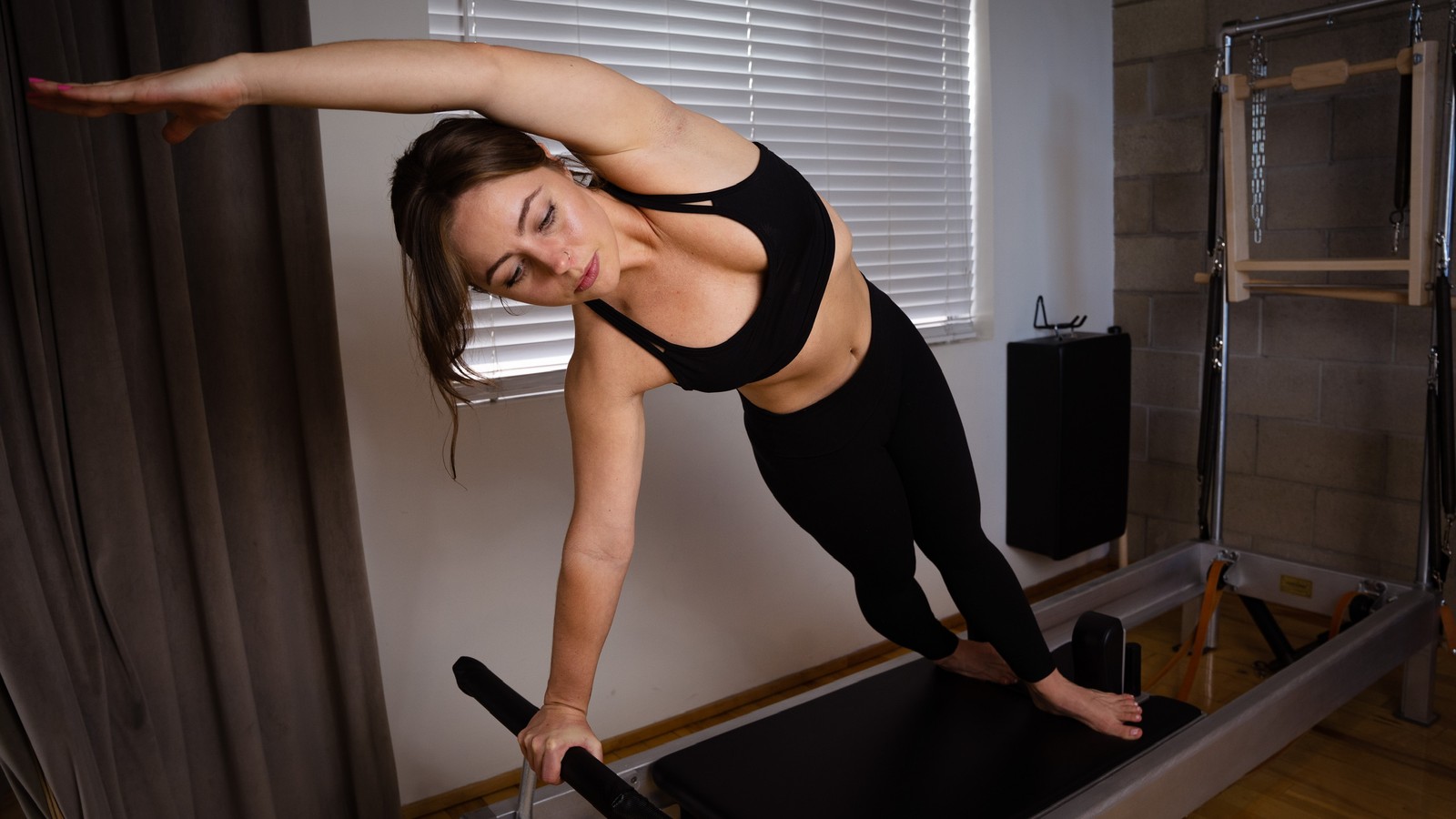
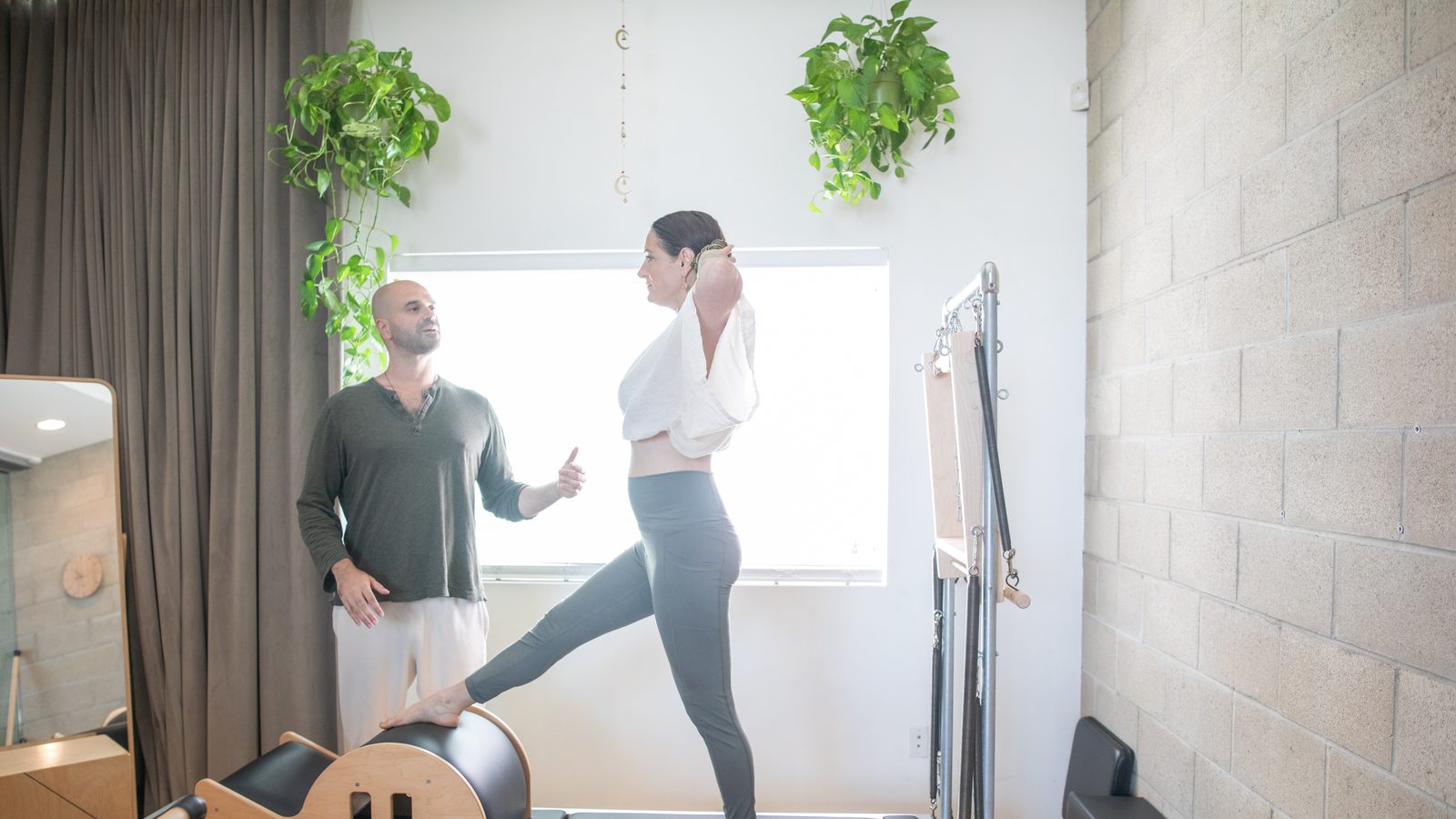
Standing Pilates is the same work, organized around the same center, done upright on your own two feet. Sometimes that means apparatus exercises performed standing. Sometimes it means taking an exercise you know lying down and asking your body to do it vertically, with nothing underneath you but the floor.
Joseph Pilates described physical fitness as “the attainment and maintenance of a uniformly developed body with a sound mind fully capable of naturally, easily, and satisfactorily performing our many and varied daily tasks with spontaneous zest and pleasure.” Daily tasks happen standing up. So does walking, dancing, carrying a child, a tennis serve, a long hike. A method built to serve that life eventually has to stand up and meet it.
In the classical order our training comes from, a session may end at the Wall. You stand with your back against it, circle the arms, roll the spine down and back up, and sink into a few squats. The teaching name for what you are looking for there is the feeling of perfect posture.
The standing work most people have never seen
If you have only done reformer work, it may surprise you how much of the classical repertoire happens upright.
- On the Cadillac, a whole family of standing arm spring work: Chest Expansion, Boxing, Shaving, the Hug. You stand facing toward or away from the springs, and the springs try to pull you off your center while your arms move.
- On the High Chair, Going Up Front asks you to step up onto the chair on one leg, which is far harder than it sounds.
- On the reformer, the Splits put you upright on a moving carriage, one foot on the platform and one on the carriage, organizing your hips over a surface that wants to slide away.
- At the Wall, the closing work above, which needs no apparatus at all.
Even the reformer’s first exercise, Footwork, prepares you for standing. It lines up the feet, knees, and hips the way they will need to line up when you are on your feet.
Standing Pilates and the planes of motion
A fair criticism of Pilates is that it spends a lot of time folding forward and arching back. That is true. The classical repertoire also twists through the Saw, the Spine Twist, and the Corkscrew, and moves side to side through Side Kicks and the Side Bend. The method was designed to move the body in every direction it moves in life.
What standing adds is gravity in a new direction. Lying on your back, the floor tells you where your pelvis and spine are. Standing, nothing does. Your center has to organize itself over the small footprint of your feet, so the same movement suddenly asks for balance on top of strength and control.
That is exactly what happened with our client. We took him through the Series of Five, the abdominal series most people know lying on the mat, and stood it up. The center and the intention stayed the same, and the problem was entirely new. Balance became a big part of the work, and because it was a new plane for his body, it challenged him, and it was hard in the session.
Why it carries into everything you love doing
Pilates was built to make the rest of your life move better. The control you build lying down is real, and standing work is where you find out whether it travels. That does not make it a level above the mat, which stays the most demanding work in the method because there is no spring there to help you.
A runner lands on one foot thousands of times on a single run, and a dancer turns on one leg. Both ask the center to hold while the body stands and balances. Standing Pilates trains that directly, and it is part of why we write about the work for runners and other sports as much as we do. For the bigger picture, our guide to Pilates for functional movement goes further, and if steadiness on your feet is your main concern, start with Pilates for better balance.
One to try at home: the Roll Down at the Wall
If you want a taste, this is the gentlest way in. Check with your doctor first if you are managing a back injury, osteoporosis, or anything that makes bending forward a question.
- Stand with your back against a wall, feet hip-width apart and a short step away from it. Let the back of your head, your upper back, and your pelvis rest against the wall.
- Breathe in. As you breathe out, nod your chin and peel your spine away from the wall one vertebra at a time, arms hanging, letting the weight of your head lead you down only as far as your pelvis can stay against the wall.
- Pause and breathe. Then roll back up from the bottom of the spine, restacking each vertebra onto the wall until your head arrives last.
Two or three slow ones are plenty. Notice where the spine wants to move as one block instead of one piece at a time. That is information, and it is the kind of thing a teacher watches for.
Why we teach it one on one
Standing work is where compensation hides best. Lose your center and the body finds another way to stay upright, often by gripping with the toes or locking the knees. In a private session we can see it the moment it happens and adjust the cue or the spring right there. West Hollywood Pilates is strictly private, with no group classes, so the progression from lying down to standing up follows your body rather than a class plan.
Every session begins with a check-in and breathwork, and it ends with a short meditation. Before our client left he said, “Wow, I feel great now.” He walked out standing just a little bit taller.
If you are curious what the standing work feels like in your own body, a private intro session at the studio on North Highland is the place to begin. There is no package to buy afterward, and you keep going only if you want to. You can also look over all our private Pilates services.
Questions people ask about standing Pilates
Is standing Pilates real Pilates? Yes. Standing work is part of the classical repertoire on the Cadillac, the High Chair and the reformer, and at the Wall. Many exercises people know lying down can also be performed standing once the center is organized enough to hold.
Is standing Pilates good for beginners? Some of it is, like the Roll Down at the Wall. Most standing apparatus work comes after the foundation is in place, because it adds balance on top of control. In a private session the teacher decides when you are ready.
Can standing Pilates help with balance? Standing work trains the center to stay organized over your feet, which is what balance asks for. It is one part of a broader practice, and anyone with a fall history or a medical concern should check with their doctor first.
We wrote a book.
The Classical Pilates Companion is 55 pages on the method as it was actually built. It comes with the letter we send on Tuesdays.
Come and feel the difference.
Your first private session is $65, refundable with 24 hours notice.