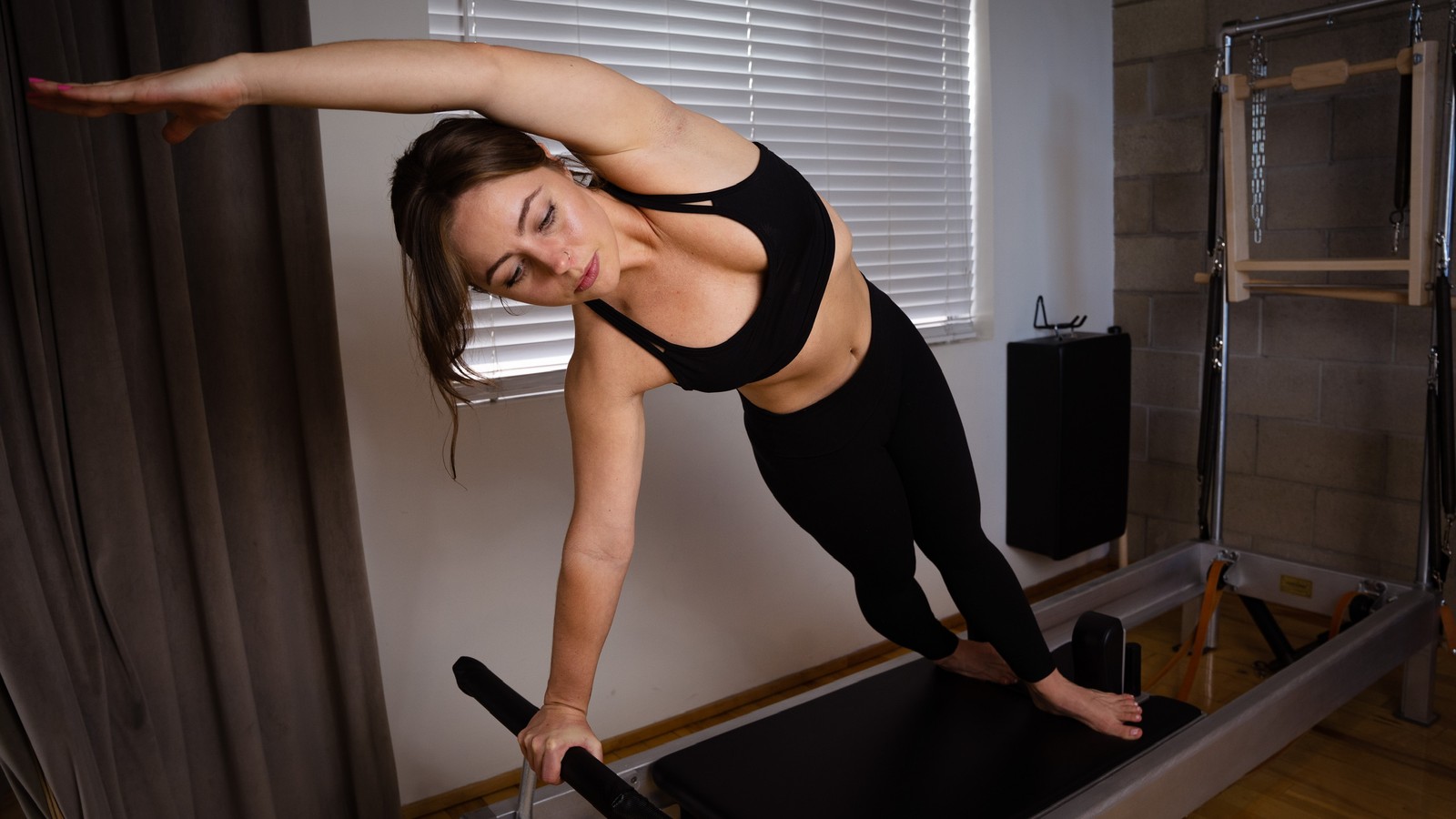
Pilates Plateau: When a Class Stops Being Enough
You have been going for months. You like it, you show up, and lately the sessions feel the same as they did in the spring. Nothing hurts. Nothing much is changing either.
A Pilates plateau is a frustrating place to sit, because the usual responses do not apply. Going harder is not really on offer in a method built on control, and going more often only helps if frequency was the problem. At West Hollywood Pilates we heard this recently from a new client, a year or so into group reformer classes around Los Angeles. A stall is information rather than a failure. It is telling you something specific about where your work is going, and that is worth finding out before you change anything.
Before you call it a plateau
Motor control improves in steps, with flat stretches in between, so four or five quiet weeks are ordinary rather than diagnostic. If you judge this week against last week you will find a plateau most months. Compare against two months ago instead, and compare something specific: whether you can now hold a position you used to lose, not whether the session felt hard.
Then rule out frequency. One session a week builds slowly and then holds, which is a perfectly good outcome if that is what you want. If you want the work to keep changing you, the answer is often a second session rather than a different kind of session. That is the cheaper experiment, so run it first. Six weeks will tell you.
What to notice in your own body
If frequency is not it, look inside the work itself. Two things are worth your attention next session, and you can check both without anyone’s help.
How small your circle has to get. Single Leg Circles looks like a hip exercise. It is a pelvis exercise. The pelvis stays completely still while the leg circles from the hip joint, which means the honest size of the circle is whatever your center can hold without rocking. It is the same test in the straps on the reformer, where the springs make a sloppy pelvis easier to get away with. Most people a year in are drawing a circle sized to their range rather than their control. Make it smaller on purpose until the pelvis goes quiet, and notice how small that turns out to be. That size reads your progress better than any new exercise you have added.
Where the Hundred lives at count sixty. At count ten the work is usually in the middle, where it belongs. By sixty it has often crept into the neck and shoulders. Watch the breath. Your ribs should widen sideways while the deep abdominals stay drawn in and up, so the center never lets go between one breath and the next. If your belly pushes out on the inhale, the center released and something else took the job.
That last one has a name in classical Pilates. Muscular bypass, which we went into properly in why Pilates is harder than it looks. The shape of an exercise outlives the point of it by a long way, so a plateau is often a compensation that settled in months ago and has been getting stronger since.
When the limit stops being the method and starts being the format
The method is not the thing that runs out. What can run out is how much of it a given format is able to deliver to you specifically.
The arithmetic of a room
A teacher with ten clients has the same hour as a teacher with one. Split evenly that is six minutes each, and it never splits evenly, because the same person is setting springs and calling the next exercise while holding the room together. None of that is a criticism of group teachers. Running a good class asks for a skill private teaching does not, which is reading a whole room and giving instruction that is safe for every body in it. What nobody can do is watch your pelvis for the ninety uninterrupted seconds it takes to see it drift.
Your body does not arrive the same way twice
A class plan is written before anyone walks in. You arrive after a bad night, or with a shoulder that was fine last week and is not fine today. Good class teachers offer options, and those options are real. But you are the one choosing between them from the outside, and the thing you cannot see is usually the exact thing limiting you.
The same cue does not land on two bodies the same way
Tell one person to draw the navel in and they find the deep layer immediately. Tell another and they grip the surface and hold their breath. Classical teaching works around this by cueing the bones into position rather than the muscles, because a bone is something you can locate. Which bone, and in which direction, depends on how you are built and what you do all day. A cue that sorts out a dancer’s back can make a desk worker’s worse.
Progression is not a longer list of harder exercises
When progress stalls the instinct is to ask for advanced work, and that is usually the wrong lever.
In the classical system the same exercise is taught at three depths. First the bones go where they belong, with simple directional cues, because correct bone position connects the center on its own. Then oppositional cues get layered on, which deepens the work without adding a spring. Last comes the version done with suspension and lightness. Your Hundred at the third depth and your Hundred at the first are different exercises with the same name.
Advancing is behavior based, not time based. You earn the next thing by achieving the concept of the current thing. One useful marker: can you begin an exercise correctly from its name alone, without being talked into position? If the setup still has to be narrated, more repertoire is not what you are short of.
What the rest of the apparatus is actually for
If your spine is not articulating on the mat, being told again to move one vertebra at a time will not help much, because you cannot feel the thing you are being asked to do. The Cadillac’s push-through bar gives you that feeling directly, and once your body has felt it the mat version has something to aim at. The Wunda Chair does the same job for standing control, which is often where a plateau hides in someone who sits all day.
So the apparatus is feedback rather than an upgrade, chosen for the thing your body currently cannot find, and it exists to hand you back to the mat better equipped. There is more on what each piece does in our post on the Cadillac and the Wunda Chair. Choosing between them in the moment is a teaching decision, which is why it only happens when one teacher is watching one person.
Who does not need private sessions
We would rather be honest than persuasive, and plenty of people are fine exactly where they are.
- If your goal is to move regularly and enjoy it, a class you actually attend beats a private session you skip.
- If class or nothing is the real choice, take the class. That is not a compromise, it is the correct decision.
- If you have a solid foundation and you are training for maintenance, a familiar weekly class is a reasonable place to keep it. Not every practice has to be going somewhere.
Private teaching earns its cost in a narrower set of cases than most studios admit. It is worth it when something specific has stopped moving and you cannot see why, or when the next step is a judgment call about your body rather than the next exercise on a list. The same goes if you are coming back from an injury or surgery, in which case bring your doctor’s clearance. We teach movement, and we are not the people to diagnose anything.
If that sounds like where you are, one session is usually enough to find out. At West Hollywood Pilates every hour is strictly private, with no group classes and no duets. The studio is at 717 N Highland Ave STE 6, Los Angeles CA 90038, a few minutes from West Hollywood. A private intro session is 55 minutes spent working out where your effort is currently going. If you would rather ask first, there is a free 15-minute call.
Common questions about a Pilates plateau
Is a Pilates plateau normal?
Yes. Motor control improves in steps, so flat stretches of several weeks are ordinary. Compare yourself against two months ago rather than last week, and compare something specific you can hold now that you could not hold then.
How do I break a Pilates plateau?
Start with frequency, because it is the cheapest thing to change and the most common cause. If that is not it, look at control rather than difficulty. Shrink your range on one exercise until your pelvis stops moving, and see whether the work comes back.
Should I switch from group classes to private Pilates?
Not automatically. Switch when something specific has stopped progressing and you cannot work out why, or when the standard cue does not land on your body. If you are mostly after more variety, a class will usually give you that for less.
Will more advanced exercises get me progressing again?
Usually not. The same exercise done with more control is harder than a new one done roughly, and depth is what a stalled practice is normally short of. Our guide to reformer and mat work covers how the two build on each other.
We wrote a book.
The Classical Pilates Companion is 55 pages on the method as it was actually built. It comes with the letter we send on Tuesdays.
Come and feel the difference.
Your first private session is $65, refundable with 24 hours notice.


