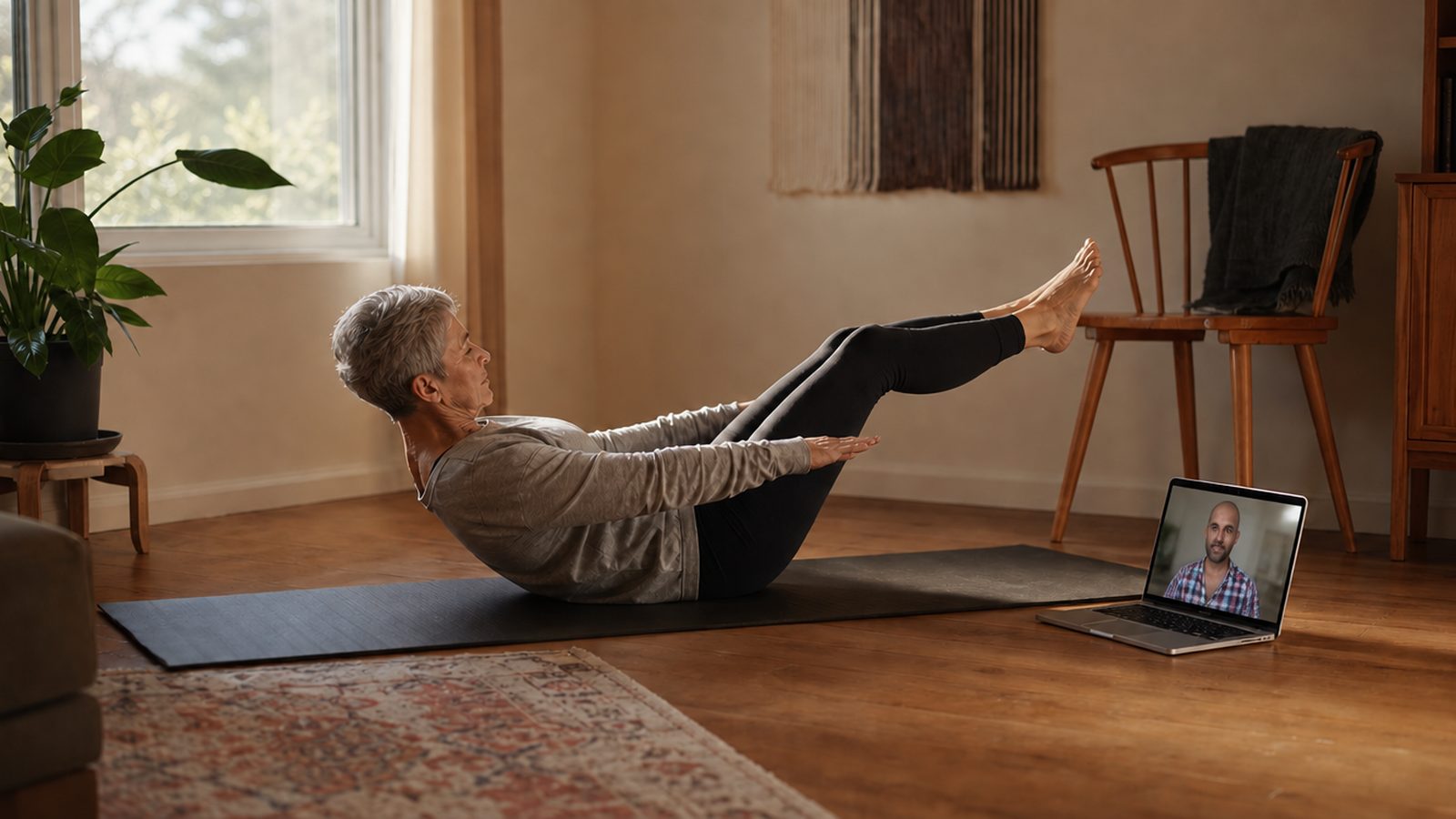
Private Pilates Online: What a Zoom Session Is Really Like
Private Pilates online sounds like a compromise. A teacher on a laptop, and no hand on your back to tell you where a movement should start. Some of that is true, and it is worth saying so before anything else. What is also true is that we teach this way every week, and the work holds. This is an honest account of what a private session over Zoom involves, and what a teacher can and cannot see through a camera. Who it serves comes after that.
West Hollywood Pilates is a one-on-one studio rather than a group class, and that does not change when the session happens on a screen. One teacher and one client, for an hour built around the body that showed up that morning.
What a private Pilates session online actually looks like
It is 55 minutes, the same length as a session in the studio, and it begins the same way. First a check-in, a short conversation about how your body arrived that day. What is sore, and what you did yesterday. Then breathwork, which is where the session actually starts, because the breath is what the movement is organized around.
Then you work. Mat repertoire and standing work, with a wall behind you when your body wants something to work against. The order is not improvised. A classical session has a shape to it, and the foundational work comes first, then the pieces chosen for what your body is asking for that day.
Every session ends with a meditation, the same way we close the hour in the studio. It is the part most people are surprised to find they needed.
One practical detail matters more than people expect. The camera goes low and to the side, a few feet back, so your teacher sees your spine in profile. A laptop on a table pointed down at you is the one setup that hides everything worth watching.
What a teacher can see through a camera, and what is lost
Start with what is lost, because it is real. There are no hands. Nobody can place your ribs where they belong or feel the tension in a shoulder before you notice it. There is no apparatus, so there is nothing supporting you or telling you where you are. If you want the reformer or the Cadillac, that is a studio visit.
Here is what is not lost, and this is the part that gets misunderstood. You do not lose the intensity, and you do not lose the method. Mat work is the hardest work in Pilates, not the gentle version of it. On the apparatus the springs support you and tell you where you are. On the mat nothing does. Your own body has to produce the control and the resistance both, which is why an honest mat session humbles people who are strong everywhere else.
That is the shape of the method itself. The mat book Joseph Pilates published in 1945, Return to Life Through Contrology, is thirty-four exercises and not one piece of apparatus. The mat is where he put the work in people’s hands. In how we teach it, the apparatus is there to give a body the feedback it needs to find what the mat is already asking of it, and then to bring you back to the mat.
So what survives a camera is more than most people assume. Classical Pilates is taught by cueing the bones into position and watching for one specific compensation at a time. That is eye and voice work. Across a screen a teacher still sees the ribs lift away from the mat during the Hundred, the neck quietly taking over what the abdominals were supposed to do, a pelvis drifting a few degrees off square during Single Leg Circles, or a breath held at exactly the hard moment. Those are the things that decide whether an exercise is doing anything for you.
What genuinely suffers is rotation and anything the camera angle flattens. We deal with that by asking you to move the laptop mid-session, which feels awkward the first time and then becomes ordinary.
Who private Pilates online works well for
- People who do not live in Los Angeles. The alternative for most of them is a class app, where nobody is watching and every body in the video gets the same instruction.
- People who travel often. The method rewards consistency far more than intensity, and a session you can take from a hotel room is a session you do not cancel.
- People for whom leaving the house is the hardest part of the hour. A caregiving schedule, or a body that does not want to sit in traffic first.
- People over 60 who want unhurried, attentive work. Private Pilates after 50 translates to a screen well, because the work is precise and slow.
- Studio clients between visits. Two sessions a week beats one, and the second does not have to be in the room.
Who we would rather see in the studio
Honesty here is part of the job.
If you are returning to movement after an injury or a surgery, come in person, at least to begin, and come with your doctor’s clearance. Hands and apparatus matter most exactly when a body is protective.
If balance is a real concern, the studio is safer. Standing work on a screen has a limit, and the limit is that nobody is standing next to you.
During pregnancy the work needs to be individualized and cleared by your provider, and we prefer to start that in person, where we can support a position with our hands as your body changes week to week.
And if you are brand new to Pilates and live anywhere near us, start in the studio if you can. Your first session gives your teacher a great deal of information that is simply easier to gather in the same room. Online works well once you have a foundation. Building one is easier in the room.
What you need at home, which is less than you think
- Enough floor for your body lying down plus room to sweep your arms out to the sides.
- A mat, or a rug that is not slippery.
- A laptop, tablet, or phone you can set on the floor or a low surface, side on.
- A clear stretch of wall. The wall is the most useful thing in the room.
- A sturdy chair with no wheels. We use it mostly with older clients, where it keeps standing work safe for a body that wants something steady to hold.
- Optional and useful: a light band, and a small pillow or folded towel.
No machine, and nothing to buy. People who have been practicing Pilates at home on their own usually have everything already.
How to start
The virtual intro session is 55 minutes for $65, booked online, and you work in it from the first minute. If you are in Los Angeles and would rather be in the room, the in-studio intro is the same length and price at the studio, 717 N Highland Ave STE 6, Los Angeles CA 90038, a few minutes from West Hollywood. After the intro, we set an ongoing schedule with you directly, on a screen, in the studio, or both.
Either way the hour is about the same thing. Not how a movement looks this week, but whether your body still does what you ask of it a decade from now.
Common questions about private Pilates online
Does private Pilates online actually work?
Yes, for mat and standing repertoire taught one to one. The teaching happens through the eye and the voice, and both travel. The tools change. The method and the difficulty do not, because mat work is the most demanding part of Pilates and nothing is assisting you.
Do I need any equipment?
No. A mat, a chair, a wall, and a device you can place low and to the side. A light band is useful later but nothing is required to start.
How often should I train online?
The same answer as in the studio: consistency beats volume. Two sessions a week is a strong rhythm for most people, and one taught well is better than five rushed. There is more on building a practice on our Pilates for beginners page.
Can I switch between online and in-studio sessions?
Yes. It is the same teacher and the same plan for your body, so the programming carries across.
We wrote a book.
The Classical Pilates Companion is 55 pages on the method as it was actually built. It comes with the letter we send on Tuesdays.
Come and feel the difference.
Your first private session is $65, refundable with 24 hours notice.


