The Downsides of Pilates, From a Studio That Teaches It
People usually ask about the downsides of Pilates once they are already interested. They want to know what they are signing up for before they spend the money, which is fair. A Pilates studio is an odd place to ask, so we will answer the way we would if you asked us across the desk at West Hollywood Pilates. Some of these downsides are real and will not go away. Others turn out to be about how Pilates gets taught, and those you can do something about.
Good Pilates costs real money
Pilates done well needs specialized equipment and a teacher who has trained for years, and both end up in the price.
Private sessions cost the most. We are a private studio, so we will say it plainly: a single 55-minute session here is $150, and packages bring that down to between $145 and $130 a session. Twice a week, that comes to more than a thousand dollars a month. A group reformer class costs a fraction of that, which is why most people start there. Our breakdown of the average cost of a Pilates class in Los Angeles compares what different formats charge and what each one actually buys. If a price is hard to read, our guide to a reasonable price for Pilates has questions you can put to any studio, including ours.
What we will not tell you is that the expensive option is right for everyone. Frequency matters a great deal in this method, and a class you can afford every week often does more for you than a private session you can only manage once a month.
You will feel it long before you see it
Pilates is slow to show up in the mirror. The early changes happen inside. You notice you are sitting taller at your desk without thinking about it, or your back is less tired after a long drive. Those changes are real, but nobody else can see them, and for someone who came in wanting a visible difference by summer it can feel like nothing is happening.
Part of this is the method itself. Classical Pilates works the deep muscles that hold you upright, and those change your posture and control before they change your shape. It is mostly low impact and it is not cardio, so it burns less than a run and builds size more slowly than heavy lifting. Whether it counts as strength training is a fair question of its own, and we answered it in is Pilates strength training. If weight loss or a big change in muscle is your main goal, Pilates on its own is probably the slower road. We would rather you knew that going in.
Progress also arrives in steps. Several flat weeks are normal, and when they stretch on there is usually a reason you can find. We wrote about that in the Pilates plateau.
A crowded class cannot correct you
Group classes can be good. Plenty of teachers run them with real skill, and many of our clients took classes for years before they came to us. Some still do. The limit is arithmetic. One teacher with a full room cannot watch your pelvis for the minute it takes to see it start to rock.
That matters because Pilates is easy to do wrong while looking right. When the deep abdominals tire, the neck and shoulders quietly take over the Hundred, or the hip flexors start doing the job of your center. Classical teachers call this muscular bypass, and we explained it in why Pilates is harder than it looks. Repeat an exercise that way three times a week for a year and you have trained the compensation, not the movement.
On a reformer, a missed correction can also mean a spring set wrong or a foot slipping off the bar. In April 2026 The Guardian reported that professional bodies in the UK were warning of a rise in reformer injuries, and one of the experts quoted called classes with 20 or 25 machines and a single instructor “deeply concerning.”1 That is UK reporting, built on what professional bodies there are seeing, and it gives no measured injury rate. The logic behind it holds anywhere, though.
Everything depends on the teacher
Teacher training in Pilates varies enormously, from short courses to programs that take years. The same Guardian piece quotes an expert saying someone in the UK could open a studio with little or no formal training.1 So one real downside is that you have to choose carefully, at the exact moment you know least about what to look for.
A few things help. A good teacher asks about your history before you lie down on anything, and changes an exercise when your body is not ready for it. Ask how they trained and for how long. Someone who is glad to answer is usually someone worth learning from.
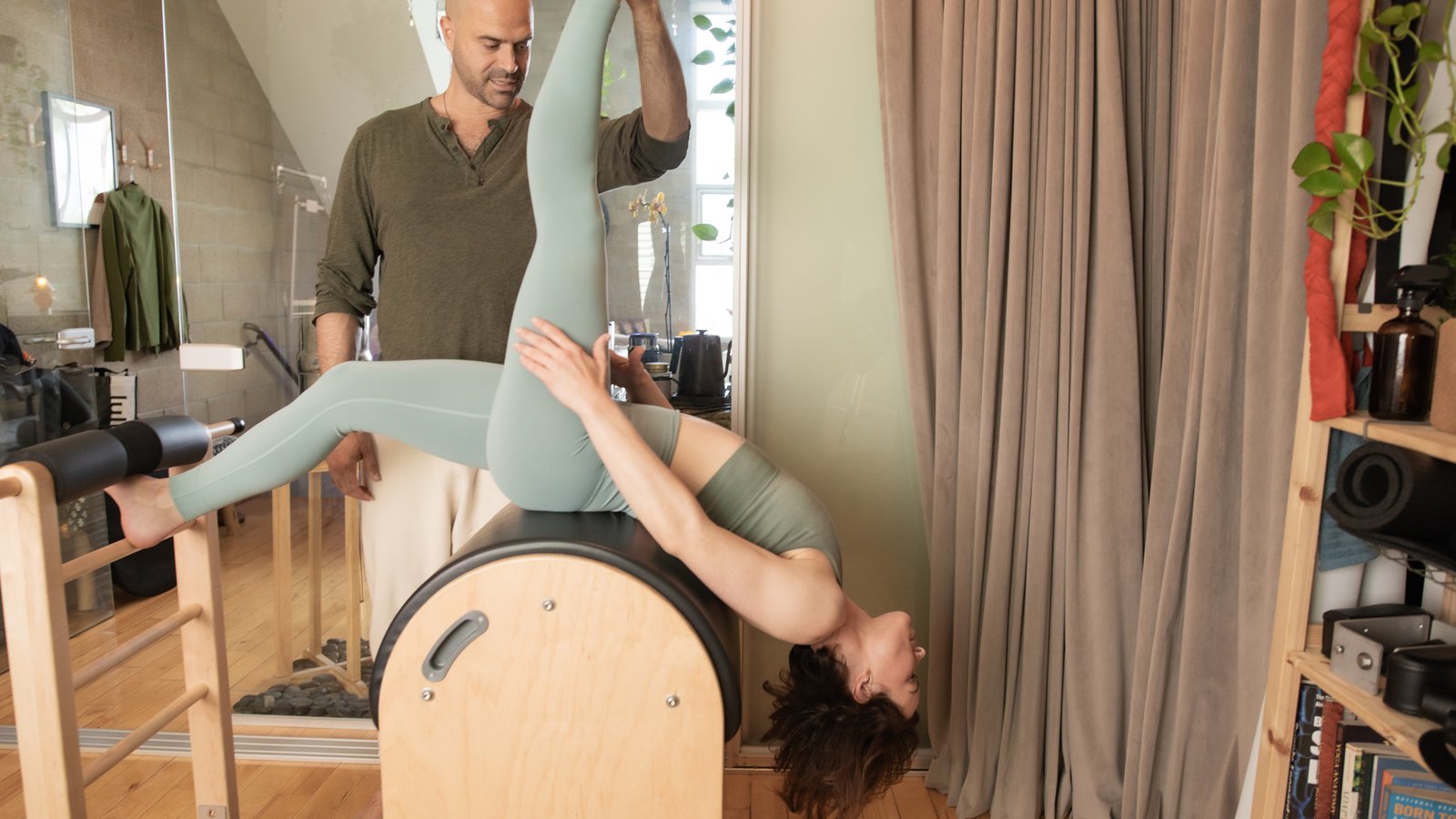
At West Hollywood Pilates, Pilates sessions are taught by Yonatan. He trained under Carrie Samper, who was certified by Romana Kryzanowska. Every session here is one-on-one.
What Pilates will not do for you
The research is encouraging, and it is also more modest than the marketing. Low back pain is one of the most studied uses of Pilates. A Cochrane review covering 10 trials and 510 people “did not find any high quality evidence” for any of the comparisons it looked at. It found low to moderate quality evidence that Pilates helped more than minimal intervention, and no conclusive evidence that it beats other forms of exercise.2 Be wary of any studio, ours included, that promises Pilates will fix a specific problem.
Pilates is also not medical care. If you are in pain or recovering from an injury or surgery, see your doctor first and bring their guidance to your teacher. The same goes for pregnancy. Pilates can sit beside that care. It should not replace it.
And it asks something of you that some people do not enjoy. The work is precise and needs your attention for the full hour. If what you want is to switch your mind off and sweat, a spin class will give you that more easily.
If you want to try it anyway
None of this is a reason to stay away. It is what we would want to know before spending money on something. If you have read this far and you are still curious, the simplest honest test is one session with a teacher watching only you.
Our private intro session is 55 minutes and $65. It is a real session: your teacher asks about your history and watches how you move, and you leave having actually worked. It is also a fair way to feel whether this studio is right for you before you commit to anything. We are at 717 N Highland Ave STE 6, Los Angeles CA 90038, a few minutes from West Hollywood. Bring your skeptical questions too.
Common questions about the downsides of Pilates
Can Pilates cause injury?
Any exercise can. Pilates is generally low impact, and most problems come from doing too much too soon, or from a compensation nobody corrected. If something hurts, stop, and see a doctor if the pain stays.
Is Pilates worth the cost?
It depends on what you want from it. If you want a pleasant way to move every week, a class you will actually attend is often the better value. Private sessions earn their price when something specific needs a trained eye.
How long does Pilates take to show results?
Most people feel a difference in how they sit and move before they see one. There is no honest universal timeline, and how often you practice matters more than anything else you control.
Is Pilates enough exercise on its own?
For many people who want to stay strong and mobile, it can be the main practice. It is not cardio, so add walking or something else that raises your heart rate.
Sources
- The Guardian. ‘Wild west’ reformer pilates boom is causing rise in injuries, experts warn. April 4, 2026.
- Yamato TP, et al. Pilates for low back pain. Cochrane Database of Systematic Reviews, 2015.
We wrote a book.
The Classical Pilates Companion is 55 pages on the method as it was actually built. It comes with the letter we send on Tuesdays.
Come and feel the difference.
Your first private session is $65, refundable with 24 hours notice.
Book an intro session - $65 Book a complimentary 15-minute call